
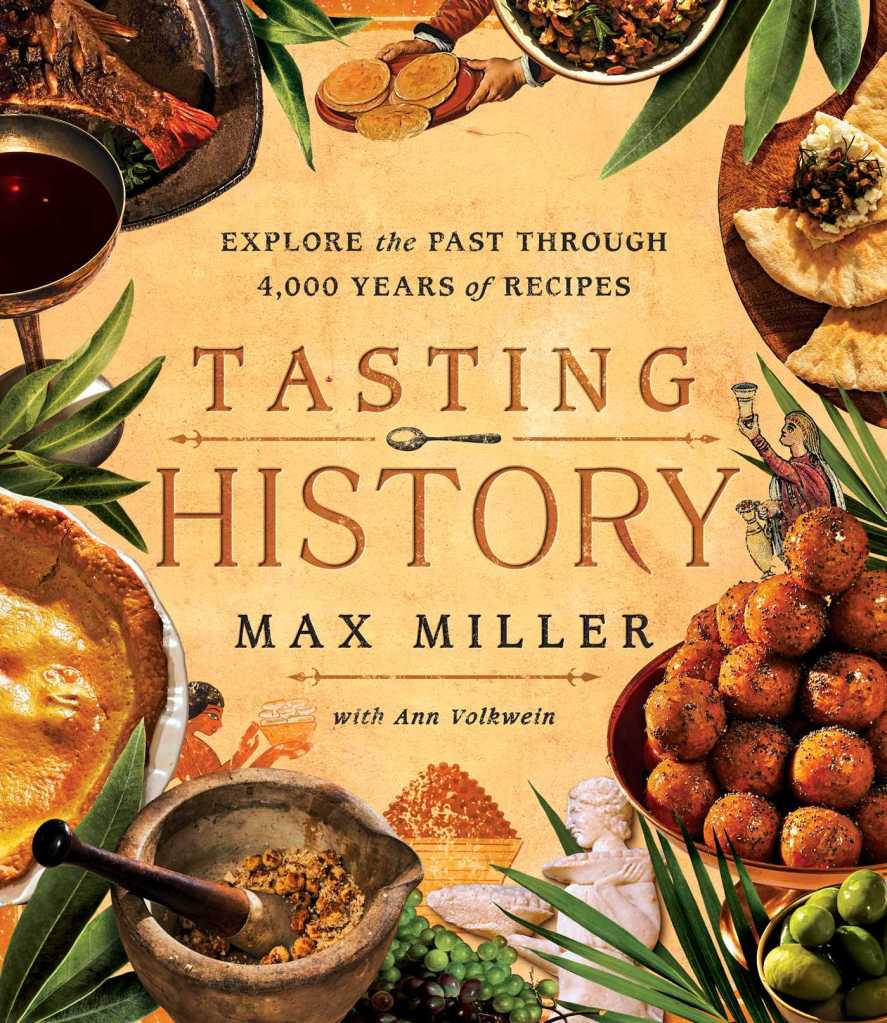
Max Miller rocketed to fame in the early days of the pandemic because his relatively new YouTube channel Tasting History about food and history was well-made and interesting. And since he had been furloughed from his job, he didn’t have anything else to do but make videos about things like how to make your own Roman-style garum at a time when a lot of other people had plenty of free time to watch videos on how to make garum. It took off so much that he ended up quitting his job and getting a cookbook published from Simon and Schuster. Not bad for someone who started making YouTube videos as a hobby at the urging of his friends, whom he jokingly suspects of doing so just because they wanted him to offload his food history trivia on strangers rather than them.
I’ve been a Tasting History fan for a couple of years now and eagerly awaited the release of the book. I was not disappointed. Thanks so much to Julie for purchasing a copy for the library and my brother for buying me a personal copy for my birthday! 🙂
If you’re not familiar with Miller’s YouTube channel, the basic gist is he posts about food history. His usual setup is to select a specific recipe from history and show you his process of making it and reaction to the final dish. In the meantime, he also intersperses fascinating information about the history and culture of the dish.
I don’t actually subscribe to many YouTube channels because I usually find them gimmicky and annoying, to be honest, but Max is an exception. He’s a delightfully charming host with a wry and witty sense of humor and a good grasp on both the food and the history. He also approaches his topics with the right blend of enthusiasm, curiosity, thoughtfulness, and lack of pretension. It’s never a dull moment to go down a food rabbit hole with Max.
I was curious how his cookbook would be set up, and I was pleased to see he adapts the method he uses in his videos well for a cookbook. Broken into a range of times and places, he covers everything from mythical Greek beverages to medieval tarts and hummus to early written versions of American pecan pie and Irish stew. His channel has a similarly broad coverage of food history, and he does a great job of not being repetitive about the content, though he has videos that cover much of the same information.
This is not a cookbook where you’re going to make every dish in it. (Unless you’re Max Miller.) If you’ve watched his channel, you’ll know a lot of his funnier and odder adventures involve trying to track down obscure historical ingredients, but he does a good job of clarifying common substitutes when he can.
In general, Max’s approach is encouraging and practical. In the cookbook, he always starts with an actual historical recipe, provides background on it (often with some really interesting deep dives into history, literature, mythology, and legend), explains his thought process for how to adapt what is often quite scant information on process and measurement to a modern kitchen, and provides step-by-step directions. The end result is a fun read in its own right and a manageable way for many home cooks to try their hand at historic recipes.
As Max readily admits, not all of these recipes are going to appeal to modern tastes, but he includes a nice mix of recognizable forebears of modern dishes and stuff that is not going to tempt many modern palates. (Spartan pork and blood soup and Navy hardtack for dinner tonight?) There’s also a good range of difficulty levels, with a solid combination of difficult recipes and fairly easy ones.
I personally really enjoyed seeing what early renditions of everything from lasagna to pancakes look like, as well as historic (and very tasty-looking) dishes from around the world that I was unfamiliar with. If you’re an ambitious Christmas cook, you’ll find lots of historic recipes to try here, from traditional figgy pudding to eggnog.
My only complaint–and it is a small one–is I wish he’d included more pictures. There are a lot of pictures of the dishes, and the ones that are there are absolutely gorgeous. (Max’s food is always a lot prettier than mine. I guess that’s why he makes the big bucks.) There’s also a lot of interesting historical art in general. But occasionally I was very curious what a dish looked like in the end and didn’t find a corresponding image for it.
If you like food and/or history, you’ll love Tasting History.
What’s your favorite cookbook? Who’s your favorite internet food personality? Have you made any Tasting History recipes? Tell us in the comments! As always, please follow this link to our online library catalog for more information on any of these items or to place them on hold.

 Berryville Book Buzz
One thought on “Max Miller’s Tasting History”