
We have a lot of fantastic digital resources, many of them courtesy of the Arkansas State Library. Because we’re a library in Arkansas, we have access to their Traveler Database. For this entire year, every month, we’re going to look at the different features available on these databases. For this month, to kick things off, we’re going to focus on how to navigate to the Research Tools on the web and also look at the General Research databases available to us.
You can easily access these databases by going to our homepage. That’s berryvillelibrary.org.

On the left-hand side, you will see a list of categories. Scroll down to Research Tools and click on it.
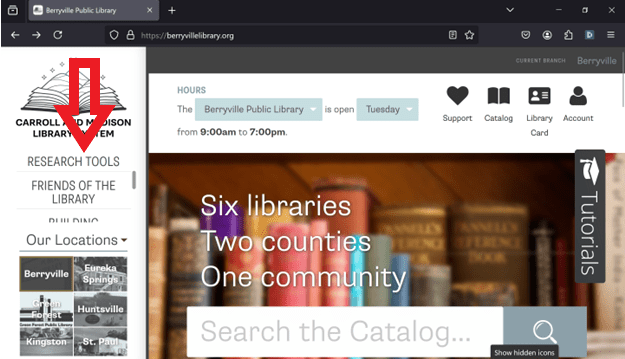
Once there, scroll down to the Traveler database and click on it.

Congratulations! You are now in the Traveler database system.
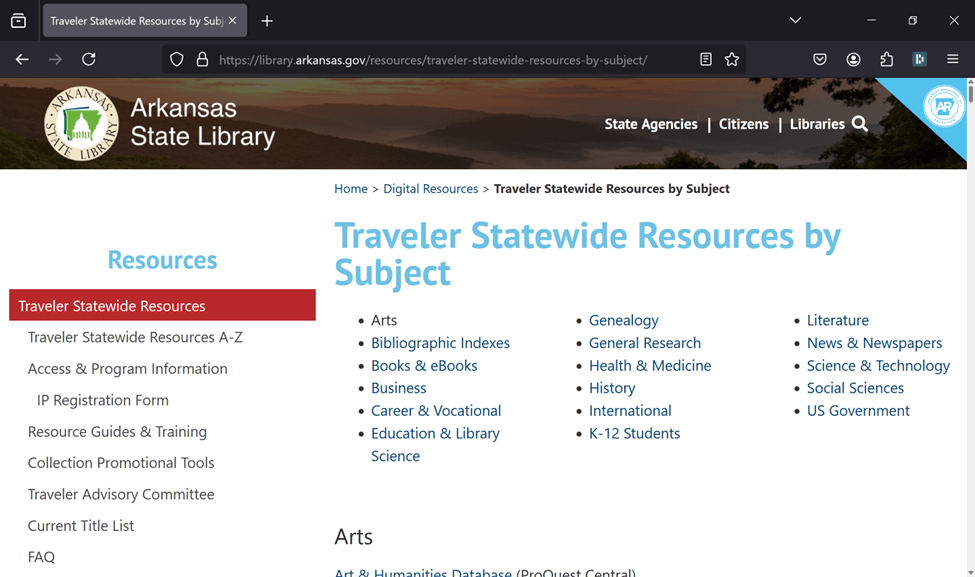
We are going to focus on General Research today, but by the end of the year, we’ll have looked at all the categories.
In General Research, there’s a long list of databases you can access. Fourteen, to be precise.
Many of them are World Book Encyclopedia databases, which are perfect for discovering general knowledge of all kinds.
You can always use the one simply titled World Book as a jumping-off point to the many databases connected with this series. Or you can use the individual tabs to select the specific World Book database you want.

These are perfect for students of any age, but the individual databases also tailor content for specific ages and reading levels. Eighth grade and up can access World Book Advanced, while elementary and middle school students can use World Book Student. Even younger learners can use World Book Kids, and students who are reading below grade level have World Book Discover at their disposal. Spanish speakers can also use Banco de Contenidos aulaPlaneta.
Beyond the encyclopedia articles World Book is known for, World Book ebooks lets you browse nonfiction titles from the publisher that you can read online or check out for offline use. World Book Timelines, meanwhile, lets you view historical timelines and even build your own!
Beyond World Book, we have several research databases that are tailormade for student researchers. For instance, eLibrary Academic is geared toward high school and college students. Its sister site eLibrary Guided Research Interface is a gentler introduction to how to use databases for newer and younger researchers that highlights common research topics for further exploration.
SIRS Discoverer is another database, this one intended for elementary and middle schoolers, as well as educators for those age groups. It features materials from over 2,000 newspapers, magazines, and websites. Its sister site, SIRS Issues Researcher, features background and analysis on hundreds of different contemporary issues. You can read about the pros and cons of everything from cell phones in school to AI. This is a great resource for both school debates/essay papers and also just any readers who want to educate themselves about current events and topics.

For adult researchers, you can access Proquest Central database and their sister site Research Library. They contain research articles on dozens of topics. If you’re researching a paper for college, this is an excellent resource. You can access scholarly research on everything from aeronautics to history to literature to agriculture.
Be sure to check out our Traveler databases, and check back in next month for another installation in this series. But you don’t wait for us to explore them! You can check them out on your own at any time day or night.
Be aware that if you are one of our Missouri-based patrons, you may not be able to access these resources at home because you need to have an Arkansas IP address. However, you can access them any time you’re at the library or anywhere in Arkansas, provided you are using an Arkansas IP address.
If you need help navigating the databases, please drop by the library, and the staff is more than happy to help.
What’s your favorite digital resource the library offers? Do you use the Traveler databases? Which of these General Research databases are you most excited to try?

 Berryville Book Buzz
11 thoughts on “Exploring Our Digital Research Tools: January”