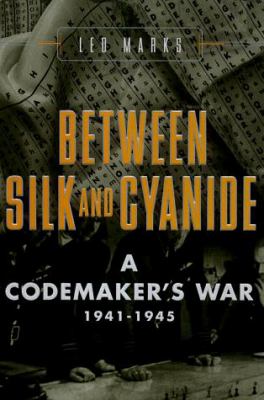
Leo Marks’s Between Silk and Cyanide

Between Silk and Cyanide

Since we’re focusing on letting the light shine on long-held secrets this month, I have a soon-to-no-longer-be secret secret confession: I love reading nonfiction about WWII-era espionage and cryptography. I blame this love on J.C. Masterman’s The Double-Cross System in the War of 1939 to 1945. It’s not in our library system, but it’s well worth requesting through ILL if you also like reading about history and/or espionage. In it, Masterman meticulously and matter-of-factly details the espionage system he ran for British intelligence in turning German agents in Britain into British double agents.

It’s a fascinating book, but it also permanently ruined espionage thrillers for me. I’ve never found a spy novel (or movie, for that matter) that captures the sheer boredom punctuated with sheer terror and the anxiety of the spy life that lurks between the lines of Masterman’s book.

That is, I hadn’t encountered it until I read Leo Marks’s insightful, hilarious memoir Between Silk and Cyanide.

Continue reading “Leo Marks’s Between Silk and Cyanide”

From Page to Screen: The Man Who Would Be King


We’ve been focusing on schools this month, but not everything worth knowing is learned in school. Sometimes the school of hard knocks delivers more memorable lessons. . . .

Daniel Dravot and Peachy Carnahan have decided that the 1880s British Empire does not appreciate their talents. And the two former British army sergeants do have a point. They feel like they’ve contributed more to building the Empire than administrators and British authorities, who are less than appreciative of their military exploits or how they have occupied themselves once they were discharged. Specifically, the powers that be are not pleased with Danny and Peachy leaving a trail of blackmail, fraud, and smuggling, among other things, in their wake.

They know that going home to England would mean menial work, which doesn’t seem very enticing given their adventures in India. But they also realize that further prospects in India are now limited, as well.

The two friends, thus, decide that they will go away to the remote, mysterious kingdom of Kafiristan. Once there, they will use their martial skills to serve as mercenaries and ingratiate themselves with a local chief as a stepping stone for them staging a coup, setting themselves up as rulers, and robbing the locals of their wealth. It’s not a retirement plan endorsed by most financial planners, but Danny and Peachy are pretty sure it will work out marvelously for them. What’s the worst that could happen?

Continue reading “From Page to Screen: The Man Who Would Be King”

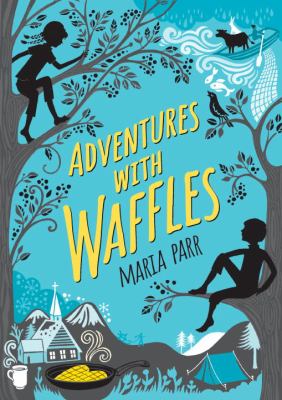
Maria Parr’s Adventures with Waffles

Adventures with Waffles

Keeping to the theme of going back to school, here’s a review of a book meant for those still having to find their desks quickly once that bell rings!

For the most part, nine year-old Trille has an idyllic childhood in rural Norway. His life is a series of never-ending adventures with his neighbor and best friend Lena. She’s far more daring and impulsive, but that doesn’t stop Trille from joining in on the fun. From snarfing down waffles to pretending to be spies to using, ahem, creative license in crafting a bonfire decoration to sledding with a chicken, they never lack for a good time. Trille can’t imagine life without Lena causing mayhem and mischief at every turn. Still, Trille harbors a disheartening suspicion that Lena is far more indifferent to him. She is his best friend, but is he her best friend?

Continue reading “Maria Parr’s Adventures with Waffles”

From Page to Screen: The Lost City of Z

It’s one of the great mysteries of 20th century exploration: what happened to Percy Fawcett?

The British military officer, surveyer, and explorer was one of the key figures in mapping and exploring the Amazon. He had become obsessed with the belief that, contrary to what other experts claimed, a large, sophisticated civilization had once existed in the dense jungle. He named that mysterious place “Z,” and he very badly wanted to find it.

In his late 50s, the undaunted Fawcett, his eldest son, and his son’s best friend plunged into Amazonia in 1925, determined to prove the world wrong. They were never seen again.

Much as how centuries before Fawcett conquistadors disappeared looking for the city of El Dorado, dozens of adventurers have also disappeared trying to locate Fawcett and/or “Z.”

After reading and enjoying David Grann’s Killers of the Flower Moon earlier this month, I decided to give his first book about Fawcett and his disappearance, which was recently adapted into a film, a try.

Beware, there be some mild spoilers ahead.

Continue reading “From Page to Screen: The Lost City of Z”

David Grann’s Killers of the Flower Moon

Killers of the Flower Moon

In the 1920s, the Osage tribe of Oklahoma were the wealthiest people per capita in the world after oil was found on their land in the early 1900s. That statistic belies the reality of the situation, though, in which many of the Osage who owned valuable headrights had to have a white guardian to control their money and financial affairs. Nonetheless, much was made of the wealth that was on the reservation.

And in 1921, wealthy tribe members started disappearing and turning up dead. Still others succumbed to suspicious instances of alcoholic poisoning and a mysterious “wasting disease.” People who began investigating the deaths also started disappearing and dying. Within a few years, over two dozen people had died under suspicious circumstances. Eventually, the FBI under a newly appointed director named J. Edgar Hoover were brought in to investigate.

As someone who is interested in the 1920s, true crime, and Native American history, I was really surprised that I had never heard of the Osage “Reign of Terror” when this book was released earlier this year.

Continue reading “David Grann’s Killers of the Flower Moon”

From Page to Screen: Victoria


When it comes to being a world builder, it doesn’t get much bigger than having an entire historical period named after you.

But when eighteen year old Alexandrina Victoria ascended to the British throne following her uncle’s death, nobody was really thinking of her future reign in such grand terms. For the most part, they were just hoping she didn’t do anything too obviously embarrassing.

Victoria’s growing pains as a young monarch in the tumultuous first couple of years of her reign is explored in a recent novel and TV series from Daisy Goodwin.

Continue reading “From Page to Screen: Victoria”

Stephanie Storey’s Oil and Marble (2016)

Oil and Marble

“Are you a Leonardo person or a Michelangelo person?”

This is the question Stephanie Storey asked me at Books in Bloom when I approached her about autographing my copy of her book Oil and Marble, a novel that chronicles the heated rivalry between two of the best artists who ever lived. Both of whom are definitely people who changed the world for the better!

Now, personally, when it comes to favorite artists, I’m a Caravaggio person. I’ve been obsessed with Caravaggio since I was a teenager. What with his strikingly realistic paintings that wonderfully capture human emotions but also absolutely horrified his 17th century contemporaries, his defiance of then-current painting tradition, his fixation on depicting decapitations (frequently starring his own severed head), and his tumultuous life (which included numerous brawls, at least one murder, being run out of several cities, and a mysterious death), he’s just always intrigued me.

But picking between Leonardo da Vinci and Michelangelo was pretty easy for me. I told her I was a Leonardo person. My dad, a talented artist in his own right, introduced me to da Vinci, one of his personal favorites, when I was a kid. (Thanks for having great taste in art, Dad!) Da Vinci’s art interested me, but the man himself was what really fascinated me. I loved that that he was talented in so many different fields, from art to engineering, and that he was so fixated on experimenting with flight. And on a personal level, as a kid who compulsively kept a journal and loved to write backwards, I always appreciated his massive collection of journals, full of mirror writing.

So, when Stephanie Storey asked me if I was a Leonardo person or a Michelangelo person, I told her I was a Leonardo person. We chatted a little about why, and then when I turned to leave, she smiled and told me she–a self-proclaimed Michelangelo person–hoped after I read the book that I’d appreciate Michelangelo too.

Continue reading “Stephanie Storey’s Oil and Marble (2016)”

From Page to Screen: The Martian


As a general rule, space travel has never interested me. It’s nothing personal against outer space–even as a kid, it never captivated me. I was always more interested in history and foreign countries than the outer reaches of the galaxy.

Likewise, science fiction that is about outer space is rarely something I read. I prefer my science fiction dystopian.

Nevertheless, I have been curious about the popularity of both the book and film versions of The Martian and decided, in the name of broadening my horizons (aka doing my part to build a better world), to give them both a try.

Continue reading “From Page to Screen: The Martian”

Jasper Fforde’s The Last Dragonslayer

The Last Dragonslayer

Dreams of bigger, better worlds don’t have to be so great that you can’t have a little bit of fun. Enter Jasper Fforde’s The Last Dragonslayer.

Jennifer Strange has her hands full overseeing a talent management company for magicians. Even when the fifteen-year-old orphan isn’t fulfilling her apprenticeship in magical management by booking wizards for plumbing jobs and magic carpet riders for food delivery, as well as soothing ruffled egos, there’s also the whole issue of magical energy becoming weaker. Strange herself doesn’t have much power, but even her once skillful clients are feeling the effects. What happens if magic runs out? How are they going to keep a roof over their heads? Where did her boss disappear to months ago when he didn’t come back home? And on top of that, there are rumors that the Last Dragonslayer is supposed to kill the last dragon in a few days. Complications ensue.

Continue reading “Jasper Fforde’s The Last Dragonslayer”

Jeff Guinn’s The Road to Jonestown

Road to Jonestown

Don’t drink the Kool-Aid.

It’s a phrase that has permanently entered the American consciousness, but it always surprises me when people don’t know that it is a reference to the infamous Jonestown Massacre in Guyana in 1978, especially when it is used flippantly.  (I once had a very awkward conversation with a college classmate about that.) Because even though we may laugh at the phrase now, there’s really nothing funny about mass suicide. (Never mind that at Jonestown they were actually drinking mostly Flavor Aid, not Kool-Aid, but that’s a different topic for another day.)

I first heard of Jonestown when I was maybe about 10, 11, 12. There was a documentary commemorating the anniversary of it on PBS, and I remember being riveted by it in absolute horror. In the years since then, I’d read some about the story and also watched on several occasions the famous 1980 miniseries Guyana Tragedy, which stars the late Powers Boothe as Jones in what has to be one of the most chilling performances ever recorded on film.

So, just in general, a recently released book promising to be the most authoritative take on the story yet would have grabbed my attention. But I was specifically compelled to read this one, which was released last month to great acclaim, because its author is rapidly becoming one of my favorite writers.

Continue reading “Jeff Guinn’s The Road to Jonestown”