
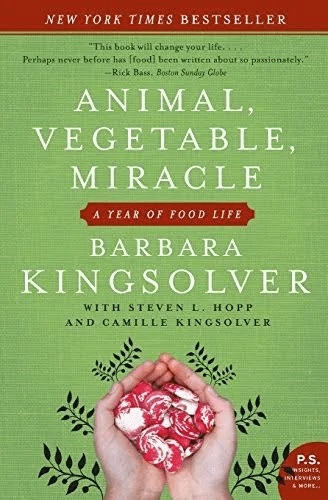
Barbara Kingsolver is best known for writing literary fiction. She’s garnered critical acclaim for decades now, between The Poisonwood Bible and Demon Copperhead, among other novels. In fact, she was at the top of the list last week in our literary fiction booklet for Exploring Genres. She started her career, however, as a science writer, and she is also a talented nonfiction author in her own right. Animal, Vegetable, Miracle is the best known of her nonfiction works, and it is well worth reading, especially this time of year when everyone’s preparing their gardens for summer.
In 2006, Kingsolver, her husband, and her two children decided to eat local for a year. Basically, other than a handful of essentials, like coffee and olive oil, they either made or grew or raised everything they ate on their farm in Appalachian Virginia, or they purchased/bartered for things local to them in season. Now, this is the kind of premise that could easily descend into a ridiculous farce in the hand of amateurs, but this isn’t this kind of book.
The family were already experienced gardeners who raised chickens and made their own cheese, so though the challenge was a stretch, it wasn’t entirely new territory for them either.
Instead, it is a memoir and an examination of a topic that is close to Kingsolver’s heart (and that of her family). In fact, the book is a family affair, with her husband and oldest daughter also contributing material throughout, though the bulk of the narrative is from Kingsolver.
She writes passionately, enthusiastically, and honestly about their experiment, and the result is an insightful, interesting, and entertaining read. Beyond talking about the glory of victory and the agony of defeat she experienced with her massive garden that year, she also writes about others she knows who are interested in the local foods and organic movement, as well as research into everything from heritage seeds to federal farming policy.
It’s a book that is interested in both the big picture and the smaller details contained therein, and it’s not all just higher-level discussions about the philosophy of food and farming. It’s also a pragmatic book that offers tips and suggestions, including recipes and seasonal weekly meal plans centered on whatever is starring in the garden that time of year. It’s also a warm, humorous look at the family’s experiences as they preserve over 200 pounds of tomatoes, attempt to dodge ambushes of their neighbors’ excess squash, raise hormonal teenage turkeys, and observe the nine-year-old’s surprisingly astute chicken farming acumen.
Animal, Vegetable, Miracle is a thought-provoking read, whether you’ve never planted a vegetable before in your life or are an experienced homesteader. Though the book is nearly 20 years old, it is still highly relevant.
Here in Berryville, we have had a real rise in the local food movement in the last couple of years. Our farmers market, Carroll County Farmers Market Association, has revamped in the past couple of years. Be sure to stop by Monday mornings and Thursday afternoons at the community center. Sometimes you’ll even see us there. 🙂 We also have Evergreen, a farm goods store, on the square that specializes in food from area farms.
We also have our annual Berryville Grows! seed library here at the library. We’ve handed out most of our free seeds for this season, but we still have Black Diamond watermelon seed packets. Come pick some up while they last.
Recommended for fans of Wendell Berry, as well as Robin Mather’s The Feast Nearby: How I Lost My Job, Buried a Marriage, and Found My Way by Keeping Chickens, Foraging, Preserving, Bartering, and Eating Locally (All on $40 a Week); Vicki Robin’s Blessing the Hands That Feed Us: What Eating Closer to Home Can Teach Us About Food, Community, and Our Place on Earth; Alisa Smith and J.B. Mackinnon’s Plenty: One Man, One Woman, and a Raucous Year of Eating Locally; Edna Lewis’s The Taste of Country Cooking; Michael Pollan’s The Omnivore’s Dilemma: A Natural History of Four Meals; and Julia Child’s My Life in France.
Have you read Animal, Vegetable, Miracle? What are you planting in your garden this year? Tell us in the comments! As always, please follow this link to our online library catalog for more information on this book or to place it on hold.


