
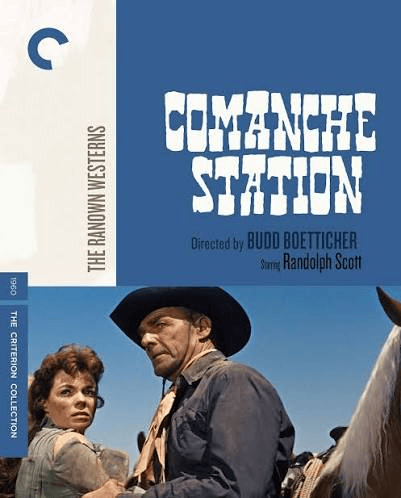
If last week’s Westerns genre booklet has you wanting to explore the Old West a little more, give this underrated little gem of a movie a try.
When Comanche Station was initially released in 1960, critics dismissed it as too repetitive of material from other Westerns, including those already made by the film’s key creative team of director Budd Boetticher, star Randolph Scott, and screenwriter Burt Kennedy. History has been kinder to what ended up being Scott’s second-to-last film, as many viewers have realized the movie stands on its own merits after all.
In the film, prickly loner Jefferson Cody (Scott) single-handedly frees captive Mrs. Lowe (Nancy Gates) from Comanche warriors after trading for her ransom. But the danger is just starting as they face a wild trek back to her home in Lordsburg, New Mexico, accompanied by morally dubious bounty hunters led by Ben Lane (Claude Akins).
Lane is very interested in and motivated by the generous $5,000 reward the curiously absent Mr. Lowe is offering for the return of his wife. With an ally like this, who needs enemies? Or so Cody is inclined to believe. Nevertheless, if Cody and Mrs. Lowe are to survive, they need every bit of help they can get, even if it comes from Lane and company.
Comanche Station is the last of the so-called Ranown Westerns of the 1950s, named for Scott’s film production company. In fact, Scott had decided it was to be his last film before he was lured out of retirement a couple of years later for Ride The High Country. The Ranown Westerns are thoughtful, complex, and laconic, with a heavy dash of realism and moral ambiguity, a bridge between the more conventionally heroic Westerns of the decade and the gritty revisionist Westerns that followed in the 1960s and 1970s.
The ever-reliable Scott shines as the courtly but morose Cody, a former Army officer with his own personal reasons for rescuing Mrs. Lowe, though Akins steals the show, in my opinion, in a fantastic performance as Lane. A stalwart of the genre, Akins was a talented, versatile actor whose cocky smirk, burly frame, and booming voice seemed tailor-made for imposing villain roles. Thus, he played a rogue’s gallery of nasty, unhinged bad guys throughout his long career, effectively menacing the likes of Matt Dillon, the Cartwrights, Lucas McCain, Jim Hardie, and John Wayne for years.
Here, his Ben Lane is affable, smart, perceptive, and competent, even charming and frequently funny in a cynical, needling sort of way. He is also bitter, crude, greedy, cut-throat, and manipulative. And the chatty, smiling former cavalryman, whom Cody had drummed out of the service years earlier, is secretly plotting a shockingly malevolent crime, even by Western badman standards. Still, he has a strange sense of fair play about it, and most Westerns don’t let villains this strategically ruthless also be this genuinely genial. A big part of the movie’s appeal is the tense rapport between Cody and Lane, which meanders between deep suspicion and reluctant respect, both equally justified.
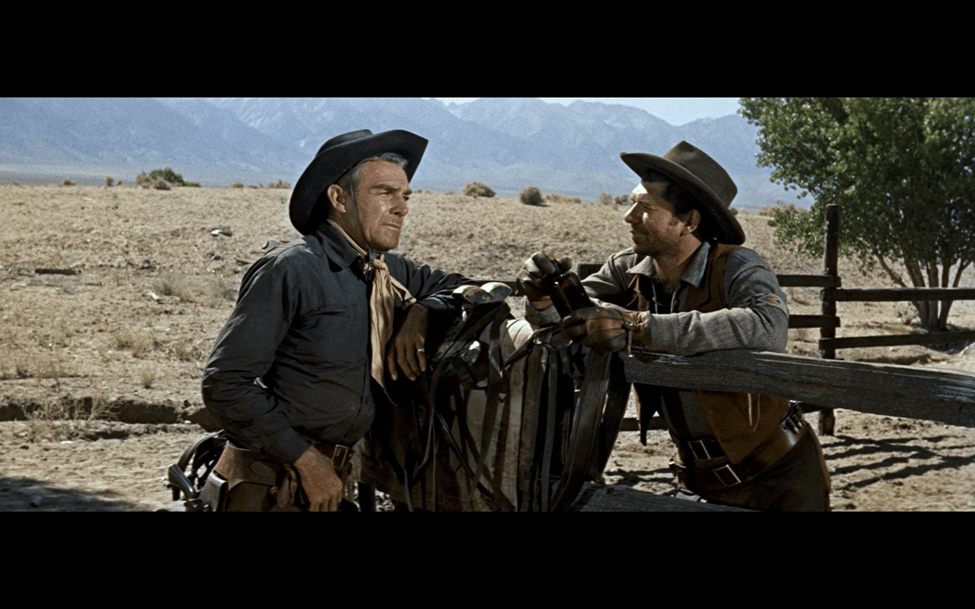
Lane’s henchmen, the practical Frank (Skip Homeier) and the soft-hearted Dobie (Richard Rust), whose gentleness disturbs and confounds his boss, also get more well-rounded parts than is usual for villainous sidekicks. Compared to the more talkative men, Gates as Mrs. Lowe keeps her own counsel and also does a good job as a refined frontierwoman placed in a difficult and confusing situation.
It’s an efficient little Western, too, clocking in at only 73 minutes, but packing an impressive amount of character development and atmosphere in that lean runtime and featuring some pretty solid action set pieces at the beginning and toward the end. It also has a great twist ending, stunning cinematography and scenery (courtesy of the Eastern Sierra), and thoughtful themes about the social exclusion of former captives, the price of loneliness, and the corrupting power of greed. Boetticher also frames and blocks the actors in interesting, effective ways that emphasize the characters’ shifting, tenuous alliances with each other.
One aspect of the film I especially appreciated was that the characters actually acted like they were having to sneak through the terrain. A lot of movies, even considerably more modern ones, feature actors in supposedly dangerous settings, who completely undermine the tension by just strolling through the scene like they don’t have a care in the world. It is one of my biggest pet peeves and instantly breaks my immersion. Not so in Comanche Station. Cody, Lane, Frank, and Dobie all seem sufficiently wary and alert as they slowly pick their way towards Lordsburg. The film also has other nice little logistical moments involving navigating, scouting, making camp, and even mule handling that believably sell Cody and Lane as former horse soldiers, as well as the rugged 19th century setting.
It is not a flawless movie, though. The biggest head-scratcher is the depiction of Lordsburg as Comanche country when it was actually deep in the heart of Apacheria. The Comanche also sport bewilderingly anachronistic mohawks. And though the men look suitably beset by their grimy surroundings, Mrs. Lowe’s hair and makeup (!) remain impeccable.
Still, I highly recommend Comanche Station. Watch it for the memorable performances and characters, beautiful scenery and cinematography, and well-plotted narrative.
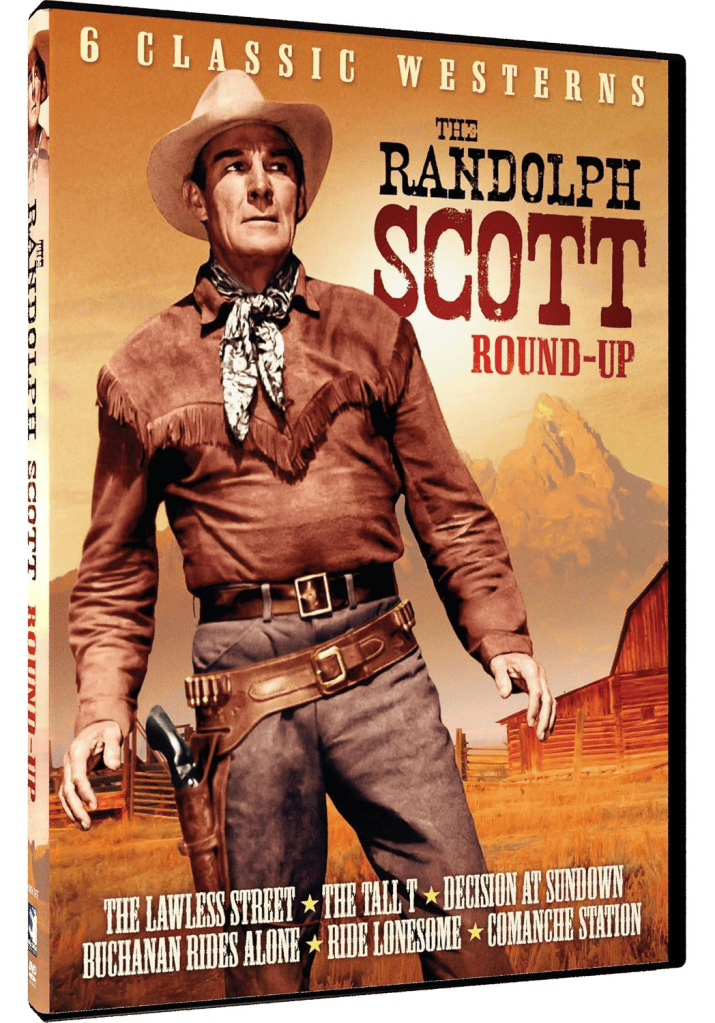
You can check out Comanche Station as part of The Randolph Scott Round-Up collection, which includes 5 other classics, among which are several other Ranown Westerns.
Have you watched Comanche Station? What’s your favorite Western? Who’s your favorite Western villain actor? What have you been watching lately? Tell us in the comments! As always, please follow this link to our online library catalog for more information on this movie or to place it on hold.


