
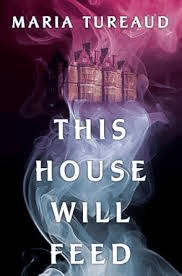
In the midst of the Irish Potato Famine, Maggie O’Shaughnessy has lost everything: her doting parents, her loving siblings, their comfortable position as the family of the land agent for the local landlord, and the man she loved. She herself is starving to death in a workhouse when she is offered a strange form of salvation. A mysterious aristocrat named Lady Catherine offers her freedom and a fresh start in exchange for Maggie pretending to be her late daughter Wilhelmina for a few months. Lady Catherine needs to trick the solicitors into believing her daughter is still alive to protect her ownership of her estate in the remote Burrens on Ireland’s West Coast, and Maggie has a passing resemblance to Wilhelmina and a refined manner thanks to her former position as a lady’s maid. Maggie accepts Lady Catherine’s offer and soon finds herself in a seemingly haunted house. Complications ensue.
Thanks so much to Julie for purchasing this book for me. I requested it after being intrigued by its review in Book Page, which you can pick up every month at our front desk, and I am so glad I asked for the book. It is an excellent read with a strong sense of place and well-drawn, complex characters.
This House Will Feed is equal parts historical fiction and gothic horror, and both genres are done exceptionally well. The haunted house aspect is suitably creepy and eerie and leads to some genuine jumps and scares, but the most uniformly horrifying aspect of this novel is its setting. Tureaud, a native of Ireland, brings the Irish Potato Famine to horrifying life, both in Maggie’s backstory and in the novel’s evocative depiction of the time and place.
In most novels I have read, the Potato Famine exists as backstory, mainly as a means of explaining why characters left Ireland, not as the actual setting. The descriptions of starvation and the desperate straits it leads to in this book are not for the faint of heart, but perhaps even more disturbing is the cruel contempt the Anglo-Irish landlords and ruling class have for the impoverished Irish living under their rule. Tureaud captures this movingly both within the story itself and in the epigraphs quoting actual historical records from the time that introduce each chapter.
As a result, This House Will Feed is not an easy read, but it is a disturbingly important one. The novel also incorporates a strong element of traditional Irish folklore and mythology and a compelling revenge story. For ultimately, that’s what almost everyone in the novel wants more than anything–vengeance.
Recommended for those who like Nadia Davids’s Cape Fever, Isabel Cañas’s The Possession of Alba Díaz, Silvia Moreno-Garcia’s Mexican Gothic, and Sarah Waters’s The Little Stranger.
Have you read This House Will Feed? What’s your favorite historical horror novel? Are you reading anything scary for Halloween? Tell us in the comments! As always, please follow this link to our online library catalog for more information on this book or to place it on hold.


